
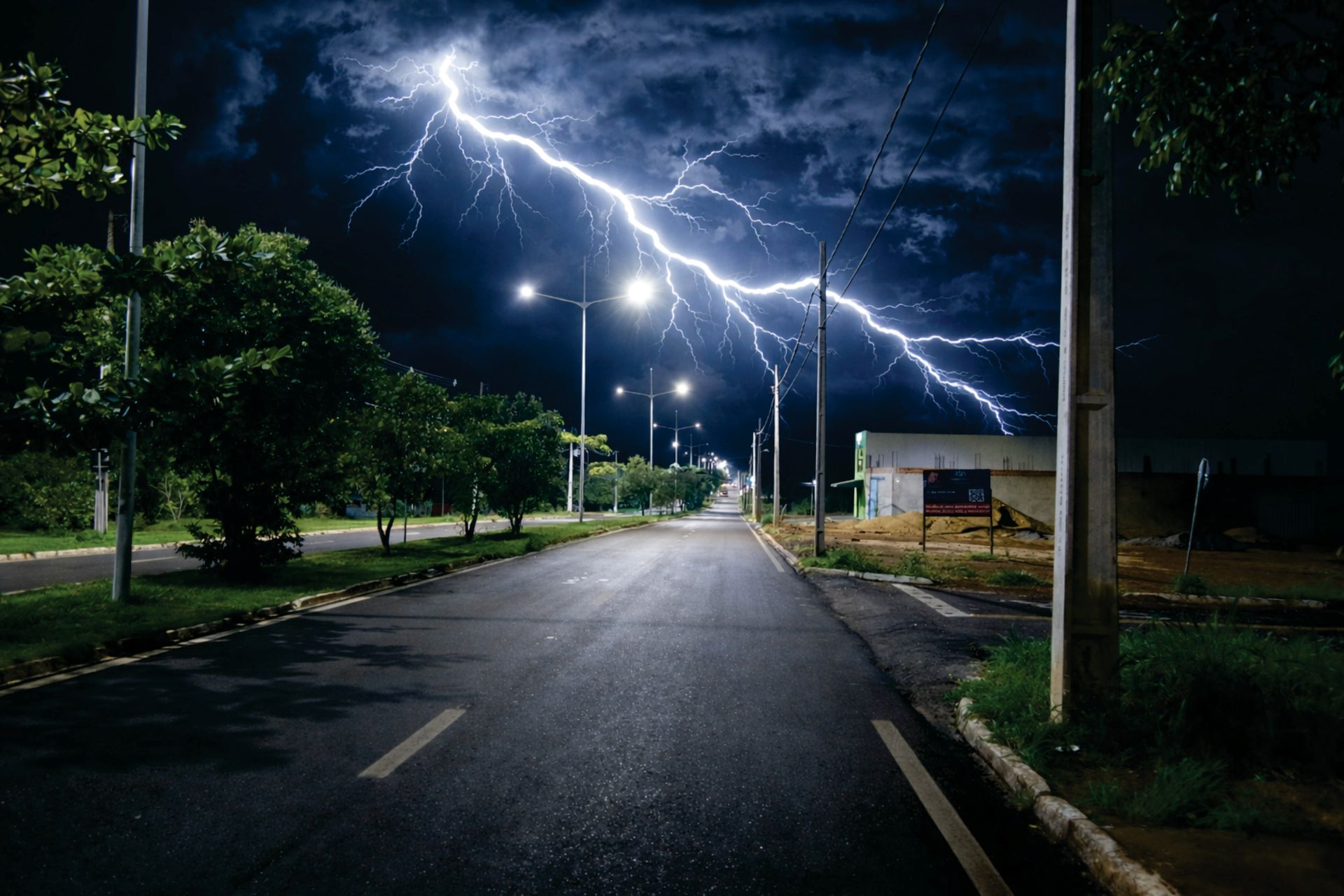
Surge Protection in Lightning-Prone Solar Systems
SA
The Electrical Sky Above South Africa
South Africa is a land where the sky does not always behave itself. On certain afternoons, especially across the Highveld and inland provinces, thunderclouds gather with theatrical intent, building electrical tension that can turn the atmosphere into a colossal, unpredictable circuit.
For solar installations, this is not just weather. It is operational risk.
Lightning activity in South Africa is among the most intense in the world, particularly in regions like Gauteng, Mpumalanga, Limpopo, and KwaZulu-Natal. These storms do not need a direct strike to cause damage. Even nearby discharges can induce voltage spikes strong enough to compromise photovoltaic systems, inverters, monitoring equipment, and communication lines.
This is where surge protection becomes less of an optional extra and more of a structural necessity in solar system design.
Why Solar Systems Are Vulnerable by Design
Solar photovoltaic systems are uniquely exposed. Unlike conventional electrical installations that sit safely within building envelopes, PV arrays live on rooftops or open ground, directly engaging with the sky.
This exposure creates multiple entry points for electrical disturbances.
Long DC cable runs between panels and inverters act like antennas, quietly collecting electromagnetic energy from nearby lightning events. Inverter units, often installed indoors or in utility spaces, become the convergence point for these surges. Even data cables linking smart monitoring systems can carry destructive transient voltages.
The vulnerability is not a flaw in solar technology. It is a consequence of its architecture.
Energy must travel from roof to inverter, and in doing so, it crosses a landscape where lightning-induced energy pulses can infiltrate at multiple stages.
Understanding Surge Events in Practical Terms
A surge is not a steady overload. It is an abrupt spike in voltage that lasts microseconds, yet carries enough energy to damage insulation layers, semiconductor junctions, and control boards.
Lightning-induced surges can occur in three primary ways:
Direct strikes, where the PV array or nearby structure is hit. Inductive coupling, where electromagnetic fields from a strike induce current in nearby conductors. Conductive entry, where surges enter through the grid or grounding systems.
Even strikes several hundred metres away can produce damaging voltage differentials across a solar installation.
This is why surge protection must be designed as a layered defence system rather than a single device solution.
The Role of SPD Devices in Solar Protection
Surge Protection Devices, commonly known as SPDs, are the first line of defence against transient voltage spikes.
Their function is deceptively simple: detect excess voltage and divert it safely to ground before it reaches sensitive equipment.
In practice, SPDs operate as fast-acting valves within the electrical system. When voltage exceeds a safe threshold, internal components such as metal oxide varistors or gas discharge tubes activate, redirecting energy away from vulnerable circuits.
In solar installations, SPDs are typically installed at multiple points:
On the DC side between PV arrays and inverters
On the AC side between inverters and distribution boards
On communication and monitoring lines where applicable
Each layer protects a different segment of the system, ensuring that no single surge path remains unguarded.
What makes SPDs especially important in South African conditions is not just their presence, but their correct specification. Undersized or improperly rated devices can fail under repeated storm activity, leaving systems exposed during peak lightning seasons.
DC Side Protection and the Inverter Bottleneck
The DC side of a solar system is where most lightning-induced damage begins.
PV panels generate direct current that travels through string cabling to the inverter. These cables, often running across rooftops or down building exteriors, can accumulate induced voltage during storm activity.
Without proper DC surge protection, this energy reaches the inverter’s input stage.
The inverter is effectively the brain of the system. It converts DC to AC, manages maximum power point tracking, and communicates with monitoring systems. Its internal electronics are sensitive, precise, and expensive to replace.
Once a surge enters the inverter, failure can be partial or catastrophic. In some cases, only the input stage is damaged. In others, the entire unit becomes inoperable.
Modern protection design therefore places DC SPDs as close as possible to the inverter input terminals. This reduces the length of unprotected conductor and limits the opportunity for induced voltage to propagate.
AC Side Protection and Grid Interaction
While DC protection handles the solar generation side, AC surge protection manages the interaction between inverter output and the building’s electrical system.
This side is equally important because grid-tied systems constantly exchange power with municipal infrastructure. During lightning events, surges can enter through the grid itself, travelling backward into the inverter.
This reverse surge pathway is often overlooked in poorly designed systems.
AC SPDs installed at distribution boards act as a final barrier. They prevent external grid disturbances from reaching the inverter and other connected appliances.
In South African urban environments, where grid stability can fluctuate and storm density is high, AC-side protection becomes a critical reinforcement layer rather than a secondary consideration.
The Inverter as the System’s Vulnerable Core
Every solar installation has a central nervous system, and that system is the inverter.
It is also the most financially and operationally sensitive component in the entire setup.
Inverters contain high-density electronic boards, switching transistors, capacitors, and control microprocessors. These components operate within tight voltage tolerances. A surge does not need to be large to cause irreversible damage; even a brief deviation beyond specification can degrade performance or trigger latent failure.
This is why inverter protection design is not limited to external SPDs alone.
Good design incorporates internal shielding, thermal protection coordination, isolation transformers in some configurations, and correct earthing strategies that ensure fault currents have a predictable path to ground.
The inverter is not just protected. It is architecturally defended through system design.
Grounding and Bonding as the Hidden Infrastructure
Surge protection devices cannot function effectively without a properly designed grounding system.
Earthing provides the physical pathway for diverted surge energy. Without it, SPDs become isolated components with nowhere to discharge excess voltage.
In solar installations, grounding must be consistent across all metallic components, including module frames, mounting structures, inverter housings, and distribution boards.
Bonding ensures that all conductive parts share the same electrical potential, reducing the risk of dangerous voltage differentials during lightning events.
In South African soil conditions, grounding performance can vary significantly depending on moisture content, mineral composition, and seasonal changes. This makes periodic testing an essential part of system maintenance rather than a one-time installation task.
Lightning Density and Regional Risk Variations
Not all regions in South Africa experience lightning risk equally.
The Highveld region is particularly known for intense summer thunderstorms. Gauteng’s elevated terrain and warm humid air masses create ideal conditions for frequent lightning formation.
Mpumalanga and Limpopo experience similar storm activity, often with high strike density over open land and agricultural zones where solar installations are increasingly common.
Coastal regions such as KwaZulu-Natal experience slightly different patterns, with moisture-heavy storm systems that still produce significant electrical activity, especially during seasonal transitions.
These regional differences influence surge protection design. Systems in high-risk zones require more robust SPD coordination, tighter grounding resistance targets, and often more frequent inspection cycles.
Design Philosophy: Layered Protection Strategy
Effective surge protection in solar systems is not a single product decision. It is a design philosophy.
A layered approach typically includes:
External lightning protection systems where required
DC surge protection near PV arrays and inverter inputs
AC surge protection at distribution boards
Communication line protection for smart monitoring systems
Proper grounding and equipotential bonding throughout
Each layer reduces the energy load reaching the next, ensuring that no single point of failure determines system survival.
In well-designed systems, the goal is not to stop lightning. That is impossible. The goal is to manage its indirect effects so that system components remain intact and operational continuity is preserved.
Common Design Mistakes in Local Installations
Many surge-related failures in solar systems are not caused by lack of equipment but by poor integration.
One common issue is placing SPDs too far from the inverter, which allows induced voltage to build along cable runs before protection is applied.
Another frequent oversight is mismatched grounding resistance values between different system components. This creates potential differences that can actually worsen surge behaviour during storms.
In some installations, AC protection is installed without corresponding DC protection, leaving half the system exposed.
There is also a tendency to treat surge protection as a compliance checkbox rather than an engineered system requirement. This leads to under-specification, especially in cost-driven projects.
Maintenance and Long-Term System Integrity
Surge protection devices are not permanent in performance. Each surge event degrades internal components slightly, even if failure is not immediately visible.
Over time, this cumulative stress reduces clamping efficiency, leaving systems progressively more vulnerable.
Regular inspection schedules should include SPD status checks, grounding resistance testing, and visual inspection of cable integrity, especially after severe storm seasons.
Inverter diagnostics can also reveal early signs of surge exposure, such as intermittent faults, communication errors, or reduced efficiency.
Maintenance is not reactive care. It is the long-term preservation of electrical stability.
The Economics of Protection Versus Replacement
There is a quiet financial truth in solar installation design.
Replacing an inverter can cost significantly more than implementing a comprehensive surge protection system during initial installation.
When scaled across commercial or multi-unit residential systems, a single lightning-induced failure can represent substantial operational downtime and repair costs.
Surge protection, therefore, is not just a technical safeguard. It is a financial risk management strategy.
In high-lightning regions, the cost-benefit ratio heavily favours robust protection design from the outset.
Integrating Surge Protection into Modern Solar Standards
As solar adoption grows across South Africa, surge protection is becoming a central part of installation standards rather than a peripheral recommendation.
Modern system design increasingly treats SPDs, grounding networks, and inverter protection coordination as core engineering requirements.
This shift reflects a broader understanding of environmental interaction. Solar systems do not operate in isolation. They exist in constant dialogue with atmospheric conditions, grid behaviour, and structural environments.
Surge protection is the translator in that dialogue, ensuring that electrical conversation remains within survivable limits.
Designing for a Storm-Active Reality
Lightning in South Africa is not an occasional disruption. It is a defining environmental characteristic.
Solar systems that ignore this reality are not incomplete by accident. They are incomplete by design.
Surge protection devices, inverter protection strategies, and grounding architecture form a unified defence system that allows renewable energy infrastructure to function reliably in one of the most electrically active regions on earth.
When properly designed, these systems do not merely survive storms. They absorb them, distribute their energy safely, and continue operating with quiet resilience.
In that sense, surge protection is not just about preventing failure. It is about enabling continuity in a sky that rarely stays still.